



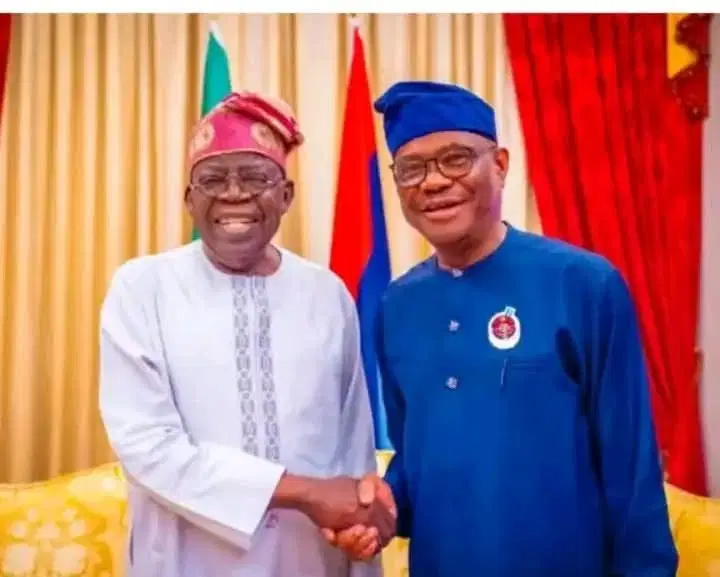
The Minister of the Federal Capital Territory (FCT), Nyesom Wike, has reaffirmed his full political support for President Bola Tinubu, insisting that his political structure in Rivers State remains firmly aligned with the President.
Wike made the declaration on Tuesday in a post on X while updating supporters on his ongoing consultations across local government areas in Rivers State.
He said he had visited Oyigbo and Ogu-Bolo local government areas on Monday and would continue his tour in Akuku-Toru and Degema LGAs.
“Yesterday, we were in Oyigbo and Ogu-Bolo LGAs. Today, we will be in Akuku-Toru and Degema LGAs,” Wike wrote.
“Here, it is local politics, and our support for Mr President is total.”
The statement comes amid rising tensions between the FCT minister and the National Secretary of the All Progressives Congress (APC), Ajibola Basiru, over influence and control in Rivers State.
On Monday, Basiru publicly challenged Wike to resign from President Tinubu’s cabinet if he could not stay out of internal party affairs. The APC scribe accused the minister of being overly preoccupied with Rivers politics despite serving in an APC-led federal government.
Basiru’s remarks followed a warning from Wike, who cautioned the APC national leadership to stay clear of Rivers State, declaring the state a political “no-go area” for external interference.
The disagreement has exposed deep divisions within the APC in Rivers, particularly around the political rivalry between Wike and Governor Siminalayi Fubara.
Last week, the APC’s South-South Vice Chairman, Victor Giadom, openly backed Wike, describing him as central to the party’s electoral strength in the state.
“To the so-called governor of Rivers State, to win anything in this state, you must go through Wike,” Giadom said.
The remark drew a swift rebuke from Basiru, who criticised the language used against Governor Fubara and warned party leaders against undermining elected officials.
“I find it unfortunate that a member of the NWC would refer to a sitting governor as a ‘so-called governor,’” Basiru said, adding that such language was inappropriate regardless of political loyalty.
Wike, however, dismissed Basiru’s intervention as unwarranted interference and responded with a strongly worded warning.
“Carrying your hands to Rivers State, if they burn, don’t say I burnt it. Don’t dare. Stop making unnecessary comments,” Wike said.
The political standoff intensified following Governor Fubara’s defection from the Peoples Democratic Party (PDP) to the APC in December, a move that further complicated internal party dynamics.
Wike has since openly opposed Fubara’s re-election bid, accusing the governor of breaching a political agreement allegedly reached before President Tinubu lifted emergency measures earlier imposed on the state.
He has also dismissed recent comments by National Security Adviser Nuhu Ribadu suggesting that President Tinubu was satisfied with Fubara’s performance.
From my experience covering intra-party power struggles, Rivers State has long functioned as a test case for grassroots control versus national party authority. Using political mapping tools and local voting-pattern data, it is clear that Wike’s strength lies in entrenched local structures, while the APC leadership faces the challenge of balancing loyalty to federal power with state-level realities.
As consultations continue across Rivers, the state remains a major flashpoint within the APC, with Wike’s influence, Tinubu loyalty, and control of political machinery shaping the evolving contest ahead of 2027.